Play poker like a rockstar? Don’t be fooled by the title.
18+ T&C Apply – To how to win at texas holdem poker every time receive the welcome bonus a minimum deposit of £/€/$ 10 is required. The minimum deposit for other offers that require a deposit will be clearly communicated. Jun 07, 2011 How to Win at Video Poker. Video poker is a popular form of gambling that provides an edge to skilled players. If you play a game with acceptable pay tables, use optimum strategy, and receive comps for your play, you can generate a slight.
Everybody can learn how to play poker like the pros (well, at least those serious enough), but winning “every” time is the tricky part.
Unless you’re a masochist, nobody likes losing and everybody wants to win every time, especially at poker when the stakes are high.
You know what I mean. Poker players, both amateurs and professionals, knew right from the start what it felt to win your first hand with a play you don’t even understand.
The sound of card shuffles, the feel of the felt, the splash of chips. They all contribute to poker’s overall appeal as a recreational game.
If you want to up your game a notch and play like the poker legends, there are so many things you can do.
But before we go on to that and give you tips on how you can improve your game and mimic the pros, allow me to clarify a bunch of stuff to make things clearer about poker in general.
Here they are:
- Poker is about two things: Math and Psychology
- It has a simple game structure, but it’s complex right down to the core
- You need funds ($$$)
EXCLUSIVE BONUS CONTENT
Get this article as a beautiful, easily save as a PDF or print for daily use.
Download an amazing infographic covering this topic to share with your friends.
Get a free copy of our popular eBook “21 Secrets to Dominate the Poker Tables Like a Pro“.
Poker Math and Psychology
I’ve met a lot of people who say that poker is about luck.
Pure luck.
You can’t beat the game because when cards are involved, you can’t do much about it.
I beg to differ.
Play Poker, just like any card or gambling games, has been subjected to many academic studies, specifically game theory and other decision-based sciences.
If this is not true, then how come there are books on how math works for poker players?
If you want to learn how to play poker like the pros and win every time, you must be ready to accept that the name of the game is probability and if you know how to capitalize on that, then you’re on your winning ways.
Probability plays a big role in each hand you play poker and the most each poker player can do is make estimates.
You can only estimate using probability what’s going to happen next. It sounds like a guessing game, but probability helps a lot if you know how to use it and you have a pretty clear idea what you’re going up against.
Sure, luck plays a role in the game, too, but in poker parlance, we call it variance.
Play poker the good old way
Simply put, the variance is the number of times a particular hand in poker is most likely to win. It’s not accurate, but at least you have a barometer to understand whether the way you’re playing is the correct way.
There’s also psychology involved. Ever heard of tells? Tells are signs people don’t know they project to other people.
If you’ve seen the movie Rounders, the tale of Matt Damon’s nemesis, John Malkovich, during their final heads-up match came in the form of Oreo cookies.
If Malkovich takes a bite of Oreos, it serves as a tell to Damon that Malkovich has a strong hand. What if he doesn’t eat it, then Damon has him beat.
But here’s a catch: it’d be sweet if we could see tells in that way when we play poker each time.
For one, that’s difficult because you have to play non-stop and iteratively to see those mundane gestures. Another would be to play with the same person over and over to understand why he plays like that in the first place.
For most professional poker players, they too can do somewhat the same. Using math, they can pretty much estimate what the other player is holding.
And just to be clear, we said estimate. I remember a new player asked me if I can tell what hand the other players are holding.
I smiled back and said, “Yes and no.”
Confused, he asked me to elaborate. It told him I couldn’t be 100 percent sure what exactly is the poker hand my opponent is holding, but I sometimes have a good “feel” of what he has depended on his poker behavior at the table.
I explained further and said that I see tells not on people’s faces, but based on their betting patterns.
You put the two together – math and psychology – then you’ve won half the battle.
Simple structure, complex game
The structure of poker is very simple: you have a bunch of people (usually a maximum of nine players per table), dealt two cards face down each and they battle it out who has the best five-card combination.
In game theory, poker is classified as “fixed game” with strict rules and an expected payout.
The player who has the best hand wins and gets paid while the rest ends up with nothing. In other words, poker is a zero-sum game. There’s only one winner.
It looks so simple, as poker greats used to say, “it takes a few minutes to learn, but a lifetime to master.”
What’s so hard about poker?
You have several players taking turns clock-wise and they’re given choices whether to call or fold, raise or re-raise.
The crux of poker being a complex game lies in vast probability and psychology the game is known for.
True, there are a finite number of cards in a deck, but the probability of landing a monster hand and getting the nuts is infinite.
Also, if you’re not prepared for the swings, poker can drive you “nuts.” I’ve seen many big men figuratively down on their knees with each bad beat and some even try to control tears from running down their cheeks.
It’s drama in real life with a thousand “what ifs” – what if I’ve played this hand differently?
What if the donkey player didn’t call?
What if I just stayed home and didn’t lose sleep?
Poker is very emotional right through a person’s core that’s why it’s a complex game.
It’s not just about cards; it’s poker.
To get money, you need money
This is the stark reality of poker as a recreational game and professional sport.
You need to be ready to shell out cash if you want to play in the game. As the cliché goes, “there’s no such thing as a free lunch.”
If you’re after the recreational side of poker and hope to win a little bit of cash, you need money.
It’s no different from watching a blood and gore movie.
You have to pay for the ticket.
Do you want to play bowling with your friends?
Then you should be ready to pay for bowling lane use.
How much more if you want to learn how
You need funds for your buy-ins. You can’t enjoy your dinner if you only have a fork and a knife. And you need a steak.
Now, let’s put these things aside temporarily and look at the following tips how you can play poker like the pros.
Before the Flop (The Opening Hand)
Just like in the game of chess, the opening hand is crucial to ensure victory or to avoid a dreadful loss.
Most beginners, especially the serious ones, have difficulty grasping this concept.
For starters, I want you to remember some basics to guide you through the process.
Opening hands to play
Although highly criticized, Phil Helmuth’s top ten opening monster hands have been guiding beginners to help them quash low- to mid-level games.
These poker hands made me start winning morewhen I first started playing poker and decided to play more seriously at the beginning of my career. From time to time I still play with these opening hands whenever it suits me and I play it aggressively.
These opening hands are very helpful especially if you’re at the beginner level and you don’t yet have an arsenal of a wide range of hands that you can play with.
Bear in mind these opening hands are not etched in stone.
Of course, you can vary your opening hand choices, but putting Helmuth’s hands would help a lot.
However, this strategy of playing “only” these monster hands fell under heavy criticisms from other professional poker players.
They argue that such advice won’t play well for beginners who are playing low-stakes games. In most low-stakes poker games (usually house games), players would play almost any hand just for the fun and recreational part of it.
Be that as it may, being dealt with monster hands is sweeter rather than just playing any suited and non-connected cards.
They will also allow you to test your strength and emotional game state how you would play each monster hand.
As you play along, you would develop the knack to develop your strategy on how to go about your game.
On Calling, Raising and Re-raising
When do you call a bet?
Do you raise?
When do you re-raise?
How much should you bet?
How much should you re-raise?
These are the common questions beginners ask as they explore poker and learn more about the game.
The answer: It depends. Really. A good barometer for calling, raising, and re-raising depends on the following factors:
- The hand you’re playing
- Your position at the table
- The size of your stack
- How you read your opponents’ tells
Hand you’re playing
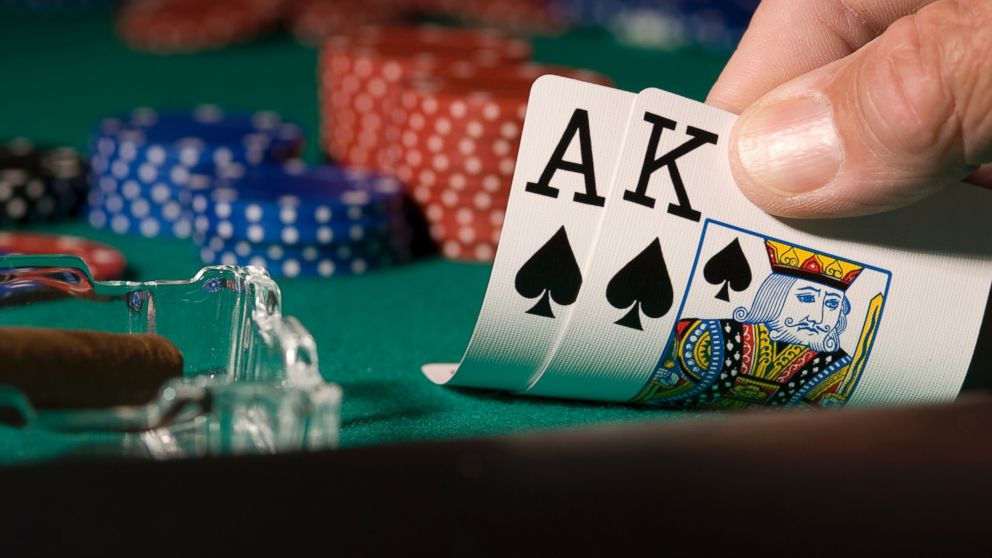
Traditional poker strategy suggests that you raise if you have a monster hand like AA (or any other monster hand of your preference) regardless of your position at the table.
The raising behavior would send a signal to other players that you’re indeed holding a monster hand.
However, your raise depends on another factor: your table image.
If you portray an image of a tight-aggressive player, your opponents are more likely to fold than engage you like that particular hand and play progress.
If you’re the type, who’s losing and would play just about any hand, expect to get called by others at the table.
Table position
If, on the other hand, you’re holding a medium pair or suited connectors like double eights, theory suggests that these hands are good to play when you’re in mid-table position and there are no raisers.
And if there are raisers in this particular hand, don’t immediately fold.
Assess the amount raised whether it’s worth playing or not.
I like playing suited connectors especially when I’m the last to act (or especially when I’m on the button).
I could hope for many possible variations of hitting something on the flop or the chance of getting a draw like a straight or a flush.
Stack size
The size of your stack is as important as the hand you’re holding.
The bigger your stack, the wider your hand range becomes.
You can experiment with different hands, but always be careful not to overdo it.
Poker is a game of attrition.
The more poker chip towers you have, the more you can dictate how you and your opponents play.
When you get a monster hand together with a huge size of chips, you can limp to suck more players in or play aggressive and go for the immediate kill.
The downside to big stacks, however, is when you get outdrawn in a play and you’ve committed a sizeable portion of your stack.
Most poker players, including pros, tend to tilt and lose composure.
In most cases, players who tilt find it difficult to shift gears and play their best as they’re sucked into a series of bad beats and bad plays.
Reading your opponents
Finding your opponents’ tells is not voodoo.
Sure, it helps when you can see if your opponent is holding his breath or shows an occasional twitch.
But it could mean so many things for so many different players.
Some players, especially beginners, would splash chips with their hands shaking.
To most pros, a shaking hand is a sign of someone holding a strong hand.
Pros (at least those you see in the movies) would normally fold their hands.
But what if the beginner’s shaking hands are not signs of strength, but of weakness?
What if that’s his last chance of getting back into the game and he knows he was already beat?
The best way to get an opponent tells is by observing the manner of his bets.
Most players, especially the good ones, vary the way they bet to hide information on what hand their playing.
Sooner or later, and when you’ve developed your poker acumen, you’ll be surprised to correctly estimate the hands your opponents are holding.
The secret is: There’s no secret. You have to play more as much as you can and learn how people behave (bet) at the table.
Invest in the game
Earlier we said that poker requires money to get money.
Well, there’s another form of cash beginners tend to overlook: Time.
Time is gold as most people say. It is. Time is the equivalent of money in its strict business sense.
In poker, you need to play at least 2,000 hours for you to get a reasonable statistics of your game to generate ample data on how you play.
To learn how to play poker like the pros and win every time means putting in the hours just like everybody else the way a bank employee kills his own time in front of a teller machine.
Apart from the 2,000 hours that you spend at the table, you also need to invest in books and videos to read and to watch how the pros do it.
Poker is an evolution in card games – it’s survival of the fittest. And the fittest are those who could adapt, mimic, and incorporate the good and throw away the bad.
How many poker books have you read so far?
How many WPT series have you seen online or on cable TV?
Have you joined poker forums and discussed your plays and exchanged ideas with other players?
This is what we mean by investment.
It’s more than the amount of money you put on the poker table both live and online.
last words
Martin Van Rue once said, “the devil is in the details.” There are many things to consider before one begins to play poker like a pro.
But you have to start to play poker somewhere.
There are so many things we can talk about and the pages of this article will run for miles and miles and still we won’t be able to cover anything.
Test the suggestions below.
Read more.
Play Poker More.
Win more.
Play poker like the pros.
Perhaps I’m one of the few that will admit it, but many years ago, when online poker was new there were at least a couple times when I loaded up my favorite search engine and entered such queries as “how to win at poker guaranteed”, “secrets of online poker winning”, and even “how to cheat at online poker”.
It is not at all uncommon for new players, or even long-term losing players, to dream that answers to such questions exist, and that a magical poker genie can make their dreams come true. But this is a poor strategy, to say the least. Players are quick to find any number of external factors that they can blame their failure on, but are slow to take responsibility for their own mistakes.
Winning at poker isn’t easy. The vast majority of people that play the game are long-term losers. In fact, even those who devote a lot of time to learning the game may still be unable to become profitable players. Below I’ve outlined some basic tips to get players started, but I must stress that these only scratch the surface. Poker is similar to sports betting, both can be beaten in long-term spans just like modern day stock exchanges.
Proper Bankroll Management is Paramount
The reality is that until you let go of the “get rich quick” mentality, your poker career probably isn’t going to go anywhere. Many poker players, even winning poker players, end up busting their online poker accounts, wiping out weeks, months, or even years of effort, simply because they don’t know how to manage their bankroll. If you move up in stakes every time you win, and fail to move down in stakes when you lose, it is almost inevitable you’ll eventually go bust.
If you’re a winning SNG player, you shouldn’t be playing a game where you can afford fewer than 40 buy-ins with your bankroll. In ring games, if you’re a fixed limit player, you’ll want to stay at stakes low enough to allow for a 300-500 big bet bankroll. When you exceed 500 bets, consider moving up in stakes. When you can afford fewer than 300 big bets, you need to move back down in stakes, and rebuild your bankroll.
The same scenario applies for NL and PL ring games, but we base these on having a 30-50 max buy-in bankroll. If you never deviate from this plan, it becomes impossible for you to truly ever go bust, and your chances of becoming a successful poker player will greatly increase.
Don’t underestimate the importance of protecting your bankroll. In a sense, doing so is all that matters. The level of risk also depends on how much you rely on poker for your income – are you a professional or a recreational player? Taking shots, moving up in limits, and dropping back down, are factors that all players must consider. However, a player can be a little less risk averse if they aren’t relying purely on poker for their income. If they go broke, at least they won’t be ruining their livelihood. That isn’t to say you should take more risks if you’re a recreational player, but doing so won’t cripple your ability to make a living.
The opposite is true of a player who relies on poker for most or all of their income. There’s no sense in taking unnecessary risks, and protecting the bankroll is of the utmost importance. As a professional player, your bankroll is your lifeblood. Just as a carpenter can’t go to work without his hammer and nails, you can’t go to work without your bankroll. Think of your poker bankroll not as mere money, but as the tools of the trade. If poker makes up your sole income or the vast majority of it, busting out will be a disaster.
When it comes to moving up in stakes, there shouldn’t be much pressure. It’s always a goal of players to move up in stakes and increase their earnings. But it’s also fine to simply settle on a certain limit, and to try and rack up the profits. Don’t feel like you need to move up just because you’ve played at a certain limit for a long time. Move up only when you feel comfortable to do so.
Manage Your Emotions: Avoid Tilting and Steaming
Even if you follow our recommended bankroll advice, tilt and steam are still major factors. To be successful at poker, you need to turn your tilt switch off, or remove the switch altogether.
The best players in poker, Phil Ivey, Tom Dwan (durrrr), and Daniel Negreanu are players who rarely go on tilt. But even when they do, it doesn’t seem to affect them much. Learn to control your emotions. Take breaks, relax, keep a healthy diet and sleep regimen, vacation often, and generally do whatever it takes to play poker without emotions. When you combine turning off your tilt switch with proper bankroll management, you’ll be 90% further along than most poker players.
Even with the above information, it will be impossible for you to play your “A” game every time you sit down at the table. Not to sound clichéd, but the old adage of “every hand is part of one lifelong session” rings true. Getting upset over a bad beat, or trying to get even if you are down on the session, might seem important at the time, but such tactics are meaningless long term.
Once you become more experienced, you will find that it’s a lot easier to get a beat on how well you’re playing. Advanced statistical programs like Hold’em Manager and PokerTracker can also do this for you, but it should always be obvious to you when you’re getting outclassed rather than simply being hit by bad luck.
Are you losing when substantially ahead? Or are you getting outplayed by superior opponents? If you’re losing hands despite being the statistical favorite, you can certainly garner some solace from your play. After a while, bad beats will simply be a part of the job, and you should be able to laugh them off without any tilt issues.
Exercise Game Selection
No matter how good you are at poker, there will always be certain games where, for whatever reason – and the factors may only exist on that particular day – you can’t win. Maybe players are cheating. Maybe your seat position sucks. Maybe an opponent has scouted you in detail, and is exploiting a leak in your game that you’re not aware even exists. Whatever the case might be, swallow your pride and leave the table when you’re struggling to win.
Too often, players persist in believing that they have a massive edge at that table, even though the evidence clearly shows that they’re struggling – if not taking a flat-out beating. Of course, there is a fine line between giving up an edge, and recognizing when something isn’t right and simply stopping for the day. But one thing is clear – if you’re a winning player, you’ll always find games you can beat. So why stay seated at one where you’re struggling to stay afloat?
How To Win In Poker
The poker media likes to create an atmosphere of glamour, making idols of the best players in the world, and turning the game into a chase to the top table. While this makes for great TV, it’s a terrible distraction for those looking to maximize their profits.
Firstly, few players have the talent to beat other elite-level talent. Players like Phil Ivey and Daniel Negreanu don’t exactly grow on trees. It’s a huge mistake to play against players of a similar or higher skill level, rather than focusing on getting into games with fish. Come up with a strategy to beat bad poker players.
Game selection is one of the most crucial factors in becoming a profitable player. In a sense, the above tips are meaningless unless you exercise good game selection. Making the most money playing online poker is a matter of finding the worst players around, and beating them. It’s as simple as that.
Tips for Winning More at Poker
How To Win At Online Poker Every Time 2017
Now that we’ve covered the fundamentals, here are some other tips for winning money playing online poker:
Win Video Poker Every Time
- Use Poker Software – Tools such as PokerTracker and Hold’em Manager with Heads-Up Display (HUD) are critical components in improving your poker game, and will help you build an edge over your opponents. They will track your play, and that of your opponents. These poker tools can also analyze your results, and show you where to improve. Every few months will see upgrades and new features being added, keeping you on top of the latest developments and trends. These are 100% must-haves for anyone serious about online poker.
- Subscribe to a Quality Training Site – Going with a monthly training site, like Deuces Cracked or Card Runners, can be one of the most affordable ways to get a leg-up on the competition. Most training sites offer a large selection of videos, produced by professional players and active forums. These can be a great way to view and learn from experts at an affordable price. Most training sites will come with yearly or monthly fees, but there’s usually a free trial period as well.
- Consider Poker Coaching – This is not important during the initial stages of your poker career, but once you find yourself reaching a level you can’t beat, you might want to hire a poker coach to get you over that hump. Today’s market is stuffed with poker coaches, and many of them are pretenders, so it’s important to do your own research before making a choice. Top end coaching can cost upwards of $300 an hour.
- Post Hands, Discuss Strategy – Develop a group of professional or semi-professional players with whom you can exchange hands and discuss strategy. Posting hands at forums is another excellent way to discuss your approach and receive advice from seasoned players. Two Plus Two (2+2) is the largest internet poker forum, and is the place where many WSOP Main Events winners learned their game. Greg “Fossilman” Raymer is a notable Two Plus Two participant who has achieved considerable success.
How To Win At Video Poker
Here conclude the tips I have for winning money playing online poker. I wish you the best of luck.